

Original content produced by Kashmir Law & Justice Project.
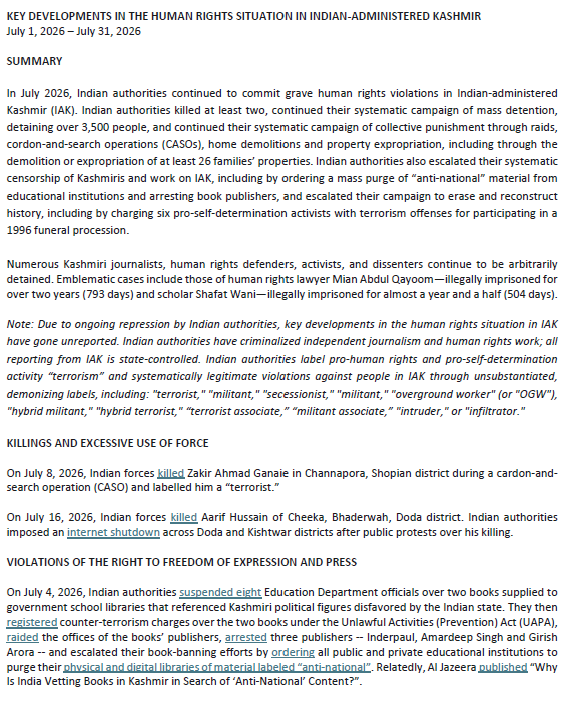
In July 2026, Indian authorities continued to commit grave human rights violations in Indian-administered Kashmir (IAK). Indian authorities killed at least two, continued their systematic campaign of mass detention, detaining over 3,500 people, and continued their systematic campaign of collective punishment through raids, cordon-and-search operations, home demolitions and property expropriation, including through the demolition or expropriation of at least 26 families’ properties. Indian authorities also escalated their systematic censorship of Kashmiris and work on IAK, including by ordering a mass purge of “anti-national” material from educational institutions and arresting book publishers, and escalated their campaign to erase and reconstruct history, including by charging six pro-self-determination activists with terrorism offenses for participating in a 1996 funeral procession.
Numerous Kashmiri journalists, human rights defenders, activists, and dissenters continue to be arbitrarily detained. Emblematic cases include those of human rights lawyer Mian Abdul Qayoom—illegally imprisoned for over two years (793 days) and scholar Shafat Wani—illegally imprisoned for almost a year and a half (504 days).
Originally published
August 2026
In July 2026, Indian authorities continued to commit grave human rights violations in Indian-administered Kashmir (IAK). Indian authorities killed at least two, continued their systematic campaign of mass detention, detaining over 3,500 people, and continued their systematic campaign of collective punishment through raids, cordon-and-search operations, home demolitions and property expropriation, including through the demolition or expropriation of at least 26 families’ properties. Indian authorities also escalated their systematic censorship of Kashmiris and work on IAK, including by ordering a mass purge of “anti-national” material from educational institutions and arresting book publishers, and escalated their campaign to erase and reconstruct history, including by charging six pro-self-determination activists with terrorism offenses for participating in a 1996 funeral procession.
Numerous Kashmiri journalists, human rights defenders, activists, and dissenters continue to be arbitrarily detained. Emblematic cases include those of human rights lawyer Mian Abdul Qayoom—illegally imprisoned for over two years (793 days) and scholar Shafat Wani—illegally imprisoned for almost a year and a half (504 days).
Originally published
August 2026
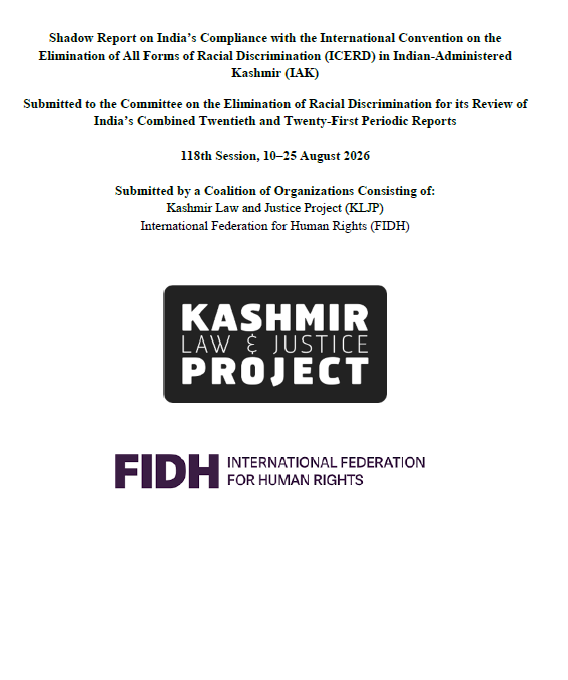
This shadow report is submitted for the CERD's review of India’s combined twentieth and twenty-first periodic reports at its 118th Session, held from 10 to 25 August 2026. It concerns India’s obligations under ICERD in Indian-administered Kashmir. The report is organized around specific issues raised by the Committee in the List of Issues Prior to Reporting (LOIPR) and is divided into three sections: 1. Grave Violations by State Forces and Structural Impunity; 2. Post-2019 Discriminatory Disempowerment and Suppression of Dissent; and 3. Hate Speech and Denial of Religious Freedom.
Originally published
July 2026
This shadow report is submitted for the CERD's review of India’s combined twentieth and twenty-first periodic reports at its 118th Session, held from 10 to 25 August 2026. It concerns India’s obligations under ICERD in Indian-administered Kashmir. The report is organized around specific issues raised by the Committee in the List of Issues Prior to Reporting (LOIPR) and is divided into three sections: 1. Grave Violations by State Forces and Structural Impunity; 2. Post-2019 Discriminatory Disempowerment and Suppression of Dissent; and 3. Hate Speech and Denial of Religious Freedom.
Originally published
July 2026

In June 2026, Indian authorities continued to commit grave human rights violations in Indian-administered Kashmir. Indian authorities exhumed the corpse of Rashid Mughal, who was killed in a March 2026 fake encounter. Jammu and Kashmir Police executed orders against lawyer and scholar Nasir Qadri for “evading arrest” in a 1996 case (when he was eight years old). Indian authorities continued their ongoing systematic campaigns of mass detention and collective punishment through raids, cordon-and-search operations and home demolitions and their ongoing systematic campaign of property expropriation, including by expropriating 1,200 kanals of prime, planted agricultural land across four villages in Pulwama and the property of the Siraj-ul-Uloom Welfare Foundation, a Muslim school and seminary in Shopian.
Numerous Kashmiri journalists, human rights defenders, activists, and dissenters continue to be arbitrarily detained. Emblematic cases include those of human rights lawyer Mian Abdul Qayoom—illegally imprisoned for over two years (758 days) and scholar Shafat Wani—illegally imprisoned for over one year (469 days).
Khurram Parvez, a human rights activist, and Irfan Mehraj, a journalist, were released on bail on July 22, 2026, after, respectively, almost five years (1,703 days) and over three years (1,219 days) of illegal, pre-trial imprisonment. Both face continued terrorism prosecutions for their human rights work; both are subject to extreme bail conditions. The Delhi High Court had previously granted bail to Parvez in another ongoing terrorism prosecution targeting him for his human rights work.
Originally published
July 2026
In June 2026, Indian authorities continued to commit grave human rights violations in Indian-administered Kashmir. Indian authorities exhumed the corpse of Rashid Mughal, who was killed in a March 2026 fake encounter. Jammu and Kashmir Police executed orders against lawyer and scholar Nasir Qadri for “evading arrest” in a 1996 case (when he was eight years old). Indian authorities continued their ongoing systematic campaigns of mass detention and collective punishment through raids, cordon-and-search operations and home demolitions and their ongoing systematic campaign of property expropriation, including by expropriating 1,200 kanals of prime, planted agricultural land across four villages in Pulwama and the property of the Siraj-ul-Uloom Welfare Foundation, a Muslim school and seminary in Shopian.
Numerous Kashmiri journalists, human rights defenders, activists, and dissenters continue to be arbitrarily detained. Emblematic cases include those of human rights lawyer Mian Abdul Qayoom—illegally imprisoned for over two years (758 days) and scholar Shafat Wani—illegally imprisoned for over one year (469 days).
Khurram Parvez, a human rights activist, and Irfan Mehraj, a journalist, were released on bail on July 22, 2026, after, respectively, almost five years (1,703 days) and over three years (1,219 days) of illegal, pre-trial imprisonment. Both face continued terrorism prosecutions for their human rights work; both are subject to extreme bail conditions. The Delhi High Court had previously granted bail to Parvez in another ongoing terrorism prosecution targeting him for his human rights work.
Originally published
July 2026
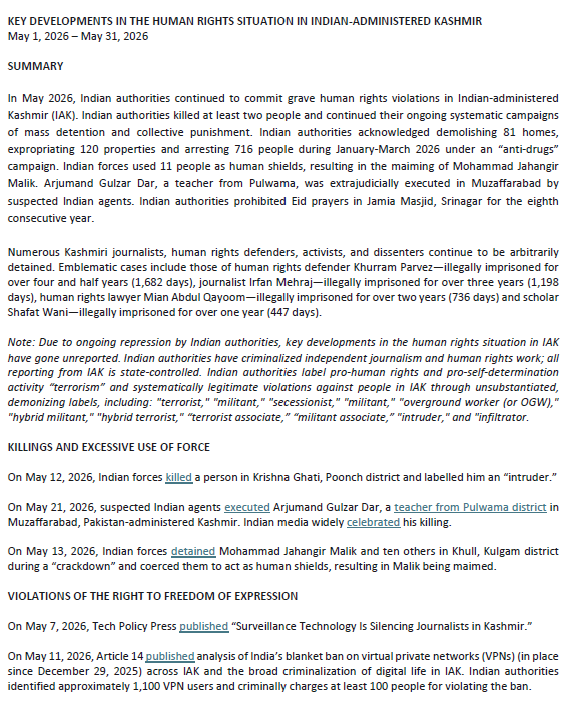
In May 2026, Indian authorities continued to commit grave human rights violations in Indian-administered Kashmir. Indian authorities killed at least two people and continued their ongoing systematic campaigns of mass detention and collective punishment. Indian authorities acknowledged demolishing 81 homes, expropriating 120 properties and arresting 716 people during January-March 2026 under an “anti-drugs” campaign. Indian forces used 11 people as human shields, resulting in the maiming of Mohammad Jahangir Malik. Arjumand Gulzar Dar, a teacher from Pulwama, was extrajudicially executed in Muzaffarabad by suspected Indian agents. Indian authorities prohibited Eid prayers in Jamia Masjid, Srinagar for the eighth consecutive year.
Numerous Kashmiri journalists, human rights defenders, activists, and dissenters continue to be arbitrarily detained. Emblematic cases include those of human rights defender Khurram Parvez—illegally imprisoned for over four and half years (1,682 days), journalist Irfan Mehraj—illegally imprisoned for over three years (1,198 days), human rights lawyer Mian Abdul Qayoom—illegally imprisoned for over two years (736 days) and scholar Shafat Wani—illegally imprisoned for over one year (447 days).
Originally published
July 2026
In May 2026, Indian authorities continued to commit grave human rights violations in Indian-administered Kashmir. Indian authorities killed at least two people and continued their ongoing systematic campaigns of mass detention and collective punishment. Indian authorities acknowledged demolishing 81 homes, expropriating 120 properties and arresting 716 people during January-March 2026 under an “anti-drugs” campaign. Indian forces used 11 people as human shields, resulting in the maiming of Mohammad Jahangir Malik. Arjumand Gulzar Dar, a teacher from Pulwama, was extrajudicially executed in Muzaffarabad by suspected Indian agents. Indian authorities prohibited Eid prayers in Jamia Masjid, Srinagar for the eighth consecutive year.
Numerous Kashmiri journalists, human rights defenders, activists, and dissenters continue to be arbitrarily detained. Emblematic cases include those of human rights defender Khurram Parvez—illegally imprisoned for over four and half years (1,682 days), journalist Irfan Mehraj—illegally imprisoned for over three years (1,198 days), human rights lawyer Mian Abdul Qayoom—illegally imprisoned for over two years (736 days) and scholar Shafat Wani—illegally imprisoned for over one year (447 days).
Originally published
July 2026
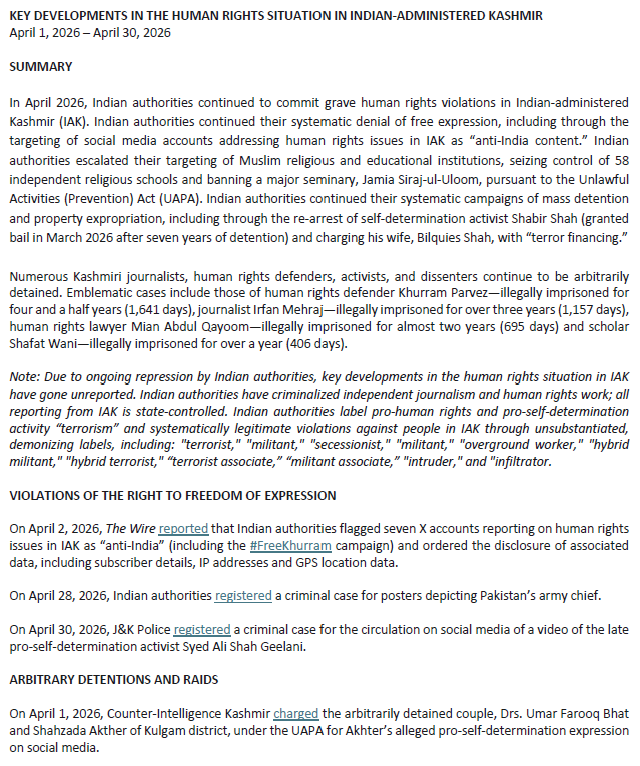
In April 2026, Indian authorities continued to commit grave human rights violations in Indian-administered Kashmir (IAK). Indian authorities continued their systematic denial of free expression, including through the targeting of social media accounts addressing human rights issues in IAK as “anti-India content.” Indian authorities escalated their targeting of Muslim religious and educational institutions, seizing control of 58 independent religious schools and banning a major seminary, Jamia Siraj-ul-Uloom, pursuant to the Unlawful Activities (Prevention) Act. Indian authorities continued their systematic campaigns of mass detention and property expropriation, including through the re-arrest of self-determination activist Shabir Shah (granted bail in March 2026 after seven years of detention) and charging his wife, Bilquies Shah, with “terror financing.”
Numerous Kashmiri journalists, human rights defenders, activists, and dissenters continue to be arbitrarily detained. Emblematic cases include those of human rights defender Khurram Parvez—illegally imprisoned for four and a half years (1,641 days), journalist Irfan Mehraj—illegally imprisoned for over three years (1,157 days), human rights lawyer Mian Abdul Qayoom—illegally imprisoned for almost two years (695 days) and scholar Shafat Wani—illegally imprisoned for over a year (406 days).
Originally published
May 2026
In April 2026, Indian authorities continued to commit grave human rights violations in Indian-administered Kashmir (IAK). Indian authorities continued their systematic denial of free expression, including through the targeting of social media accounts addressing human rights issues in IAK as “anti-India content.” Indian authorities escalated their targeting of Muslim religious and educational institutions, seizing control of 58 independent religious schools and banning a major seminary, Jamia Siraj-ul-Uloom, pursuant to the Unlawful Activities (Prevention) Act. Indian authorities continued their systematic campaigns of mass detention and property expropriation, including through the re-arrest of self-determination activist Shabir Shah (granted bail in March 2026 after seven years of detention) and charging his wife, Bilquies Shah, with “terror financing.”
Numerous Kashmiri journalists, human rights defenders, activists, and dissenters continue to be arbitrarily detained. Emblematic cases include those of human rights defender Khurram Parvez—illegally imprisoned for four and a half years (1,641 days), journalist Irfan Mehraj—illegally imprisoned for over three years (1,157 days), human rights lawyer Mian Abdul Qayoom—illegally imprisoned for almost two years (695 days) and scholar Shafat Wani—illegally imprisoned for over a year (406 days).
Originally published
May 2026