


Original content produced by Kashmir Law & Justice Project.
In June 2026, Indian authorities continued to commit grave human rights violations in Indian-administered Kashmir. Indian authorities exhumed the corpse of Rashid Mughal, who was killed in a March 2026 fake encounter. Jammu and Kashmir Police executed orders against lawyer and scholar Nasir Qadri for “evading arrest” in a 1996 case (when he was eight years old). Indian authorities continued their ongoing systematic campaigns of mass detention and collective punishment through raids, cordon-and-search operations and home demolitions and their ongoing systematic campaign of property expropriation, including by expropriating 1,200 kanals of prime, planted agricultural land across four villages in Pulwama and the property of the Siraj-ul-Uloom Welfare Foundation, a Muslim school and seminary in Shopian.
Numerous Kashmiri journalists, human rights defenders, activists, and dissenters continue to be arbitrarily detained. Emblematic cases include those of human rights lawyer Mian Abdul Qayoom—illegally imprisoned for over two years (758 days) and scholar Shafat Wani—illegally imprisoned for over one year (469 days).
Khurram Parvez, a human rights activist, and Irfan Mehraj, a journalist, were released on bail on July 22, 2026, after, respectively, almost five years (1,703 days) and over three years (1,219 days) of illegal, pre-trial imprisonment. Both face continued terrorism prosecutions for their human rights work; both are subject to extreme bail conditions. The Delhi High Court had previously granted bail to Parvez in another ongoing terrorism prosecution targeting him for his human rights work.
Originally published
July 2026
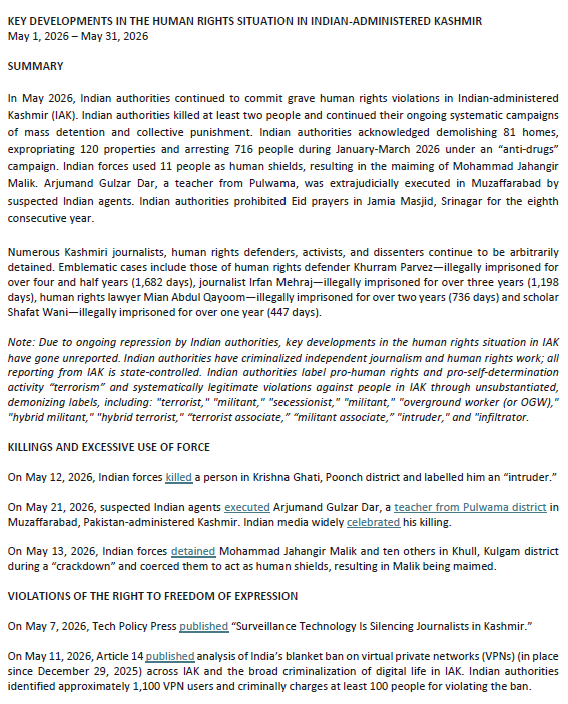
In May 2026, Indian authorities continued to commit grave human rights violations in Indian-administered Kashmir. Indian authorities killed at least two people and continued their ongoing systematic campaigns of mass detention and collective punishment. Indian authorities acknowledged demolishing 81 homes, expropriating 120 properties and arresting 716 people during January-March 2026 under an “anti-drugs” campaign. Indian forces used 11 people as human shields, resulting in the maiming of Mohammad Jahangir Malik. Arjumand Gulzar Dar, a teacher from Pulwama, was extrajudicially executed in Muzaffarabad by suspected Indian agents. Indian authorities prohibited Eid prayers in Jamia Masjid, Srinagar for the eighth consecutive year.
Numerous Kashmiri journalists, human rights defenders, activists, and dissenters continue to be arbitrarily detained. Emblematic cases include those of human rights defender Khurram Parvez—illegally imprisoned for over four and half years (1,682 days), journalist Irfan Mehraj—illegally imprisoned for over three years (1,198 days), human rights lawyer Mian Abdul Qayoom—illegally imprisoned for over two years (736 days) and scholar Shafat Wani—illegally imprisoned for over one year (447 days).
Originally published
July 2026
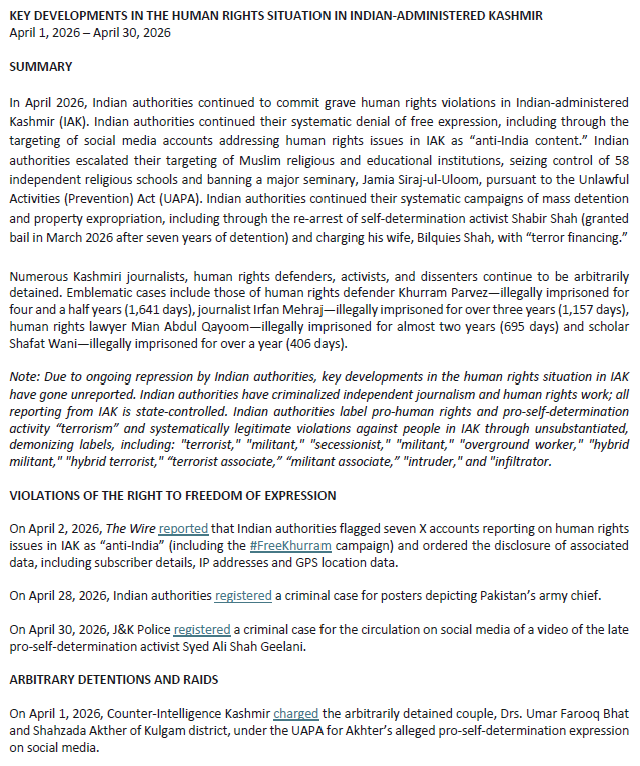
In April 2026, Indian authorities continued to commit grave human rights violations in Indian-administered Kashmir (IAK). Indian authorities continued their systematic denial of free expression, including through the targeting of social media accounts addressing human rights issues in IAK as “anti-India content.” Indian authorities escalated their targeting of Muslim religious and educational institutions, seizing control of 58 independent religious schools and banning a major seminary, Jamia Siraj-ul-Uloom, pursuant to the Unlawful Activities (Prevention) Act. Indian authorities continued their systematic campaigns of mass detention and property expropriation, including through the re-arrest of self-determination activist Shabir Shah (granted bail in March 2026 after seven years of detention) and charging his wife, Bilquies Shah, with “terror financing.”
Numerous Kashmiri journalists, human rights defenders, activists, and dissenters continue to be arbitrarily detained. Emblematic cases include those of human rights defender Khurram Parvez—illegally imprisoned for four and a half years (1,641 days), journalist Irfan Mehraj—illegally imprisoned for over three years (1,157 days), human rights lawyer Mian Abdul Qayoom—illegally imprisoned for almost two years (695 days) and scholar Shafat Wani—illegally imprisoned for over a year (406 days).
Originally published
May 2026
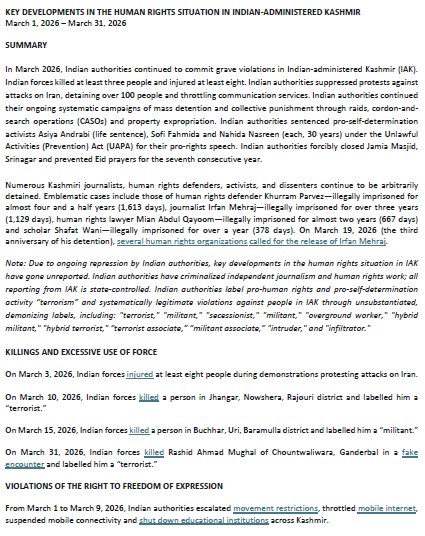
In March 2026, Indian authorities continued to commit grave violations in Indian-administered Kashmir. Indian forces killed at least three people and injured at least eight. Indian authorities suppressed protests against attacks on Iran, detaining over 100 people and throttling communication services. Indian authorities continued their ongoing systematic campaigns of mass detention and collective punishment through raids, cordon-and-search operations and property expropriation. Indian authorities sentenced pro-self-determination activists Asiya Andrabi (life sentence), Sofi Fahmida and Nahida Nasreen (each, 30 years) under the Unlawful Activities (Prevention) Act for their pro-rights speech. Indian authorities forcibly closed Jamia Masjid, Srinagar and prevented Eid prayers for the seventh consecutive year.
Numerous Kashmiri journalists, human rights defenders, activists, and dissenters continue to be arbitrarily detained. Emblematic cases include those of human rights defender Khurram Parvez—illegally imprisoned for almost four and a half years (1,613 days), journalist Irfan Mehraj—illegally imprisoned for over three years (1,129 days), human rights lawyer Mian Abdul Qayoom—illegally imprisoned for almost two years (667 days) and scholar Shafat Wani—illegally imprisoned for over a year (378 days).
Originally published
April 2026
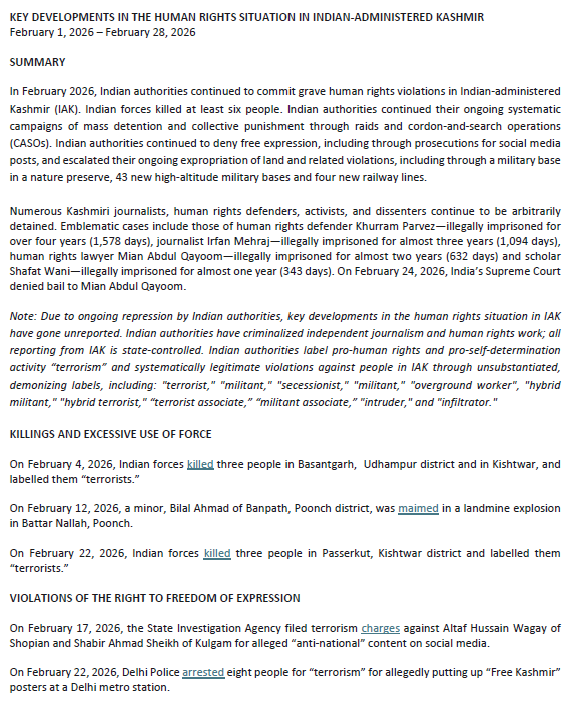
In February 2026, Indian authorities continued to commit grave human rights violations in Indian-administered Kashmir. Indian forces killed at least six people. Indian authorities continued their ongoing systematic campaigns of mass detention and collective punishment through raids and cordon-and-search operations. Indian authorities continued to deny free expression, including through prosecutions for social media posts, and escalated their ongoing expropriation of land and related violations, including through a military base in a nature preserve, 43 new high-altitude military bases and four new railway lines.
Numerous Kashmiri journalists, human rights defenders, activists, and dissenters continue to be arbitrarily detained. Emblematic cases include those of human rights defender Khurram Parvez—illegally imprisoned for over four years (1,578 days), journalist Irfan Mehraj—illegally imprisoned for almost three years (1,094 days), human rights lawyer Mian Abdul Qayoom—illegally imprisoned for almost two years (632 days) and scholar Shafat Wani—illegally imprisoned for almost one year (343 days). On February 24, 2026, India’s Supreme Court denied bail to Mian Abdul Qayoom.
Originally published
March 2026